Showing posts with label Arts and Crafts movement. Show all posts

Monday, December 10, 2012

Arts and Crafts Movement


The Arts and Crafts Movement was
about bringing life into art. Most of
Morris' wallpaper portray images of
nature, flowers, and animals. (Garden
Lily
, 1870, William Morris)
The influences of the Arts and Crafts Movement were especially significant between the years 1860-1910. The movement was sparked in Britain by the modern medieval architecture of The Red House. The movement quickly spread across Europe and into North America.

The Industrial Revolution brought poor treatment
to the factory workers. Many machines were
made to the height of children because many
started working at a very young age. 

The Industrial Revolution was a period which  brought great changes to ideas of work and craftsmanship world-wide. By the mid-nineteenth century, people were becoming concerned about the effects on the human spirit of living in an industrially produced landscape. The Arts and Crafts Movement challenged many of the core beliefs of the Victorian era. From critique of the poor treatment received by factory workers arose a voicing of anti-industrial sentiments in society. William Morris, the owner and co-designer of the Red House, was strongly influenced by the writings of art critic John Ruskin on this topic. Morris would become a leading figure in the Arts and Crafts Movement with the realization of the Red House. William Morris, John Ruskin, and many others who followed a similar system of belief held had strong desires to return to a Pre-Rennaisance way of life. The Arts and Crafts Movement was largely a response to the poor state of many arts during the Industrial Revolution, and a reaction for promoting handcrafted artifacts. In this movement, quality was valued over quantity, and craftsmanship over technology.  

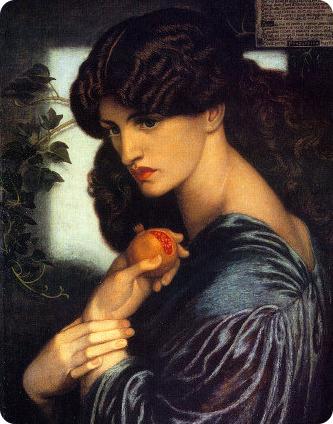
In many of Morris' paintings,
he turned his wife, Jane Morris,
into images of the romantic
ideal beauty through emphasizing
her mournful features
During the years that William Morris lived in the Red House, he and numerous friends—including Edward Burne-Jones, Philip Webb, and Dante Gabriel Rossetti—started and ran a company called Morris, Marshall, Faulkner & Co (1861-1875). The main objective of the company was to create decorative interior objects, such included: textiles, wallpaper, stain glass, and furniture. In many ways, the Arts and Crafts Movement and the story of the Red House were tales of romance; both promoted the loving relationship of providing sources of joy and pleasure to the makers and the consumers.

However, even though the idea of the movement was encouraging in its way of promoting creativity, only the very wealth could afford purely handcrafted pieces in the time of industrialization. This was the main flaw behind the idea of the Arts and Crafts Movement; due to this, the idea of art making for the people was lost since it really was only available to the selected few that could afford it. In the end, as the popularity of the Arts and Crafts spread from continents to continents, it began to merge with movements that involved more general interest in design, such as the Art Nouveau--art of continuous, organic, and long line art form. 


----------------  


Citation:


"Handmade in Canada - The Art of Craft. 'The Arts and Crafts Movement.'" CBC Digital Archives. Video 
file, 19:14. Accessed December 10, 2012. http://www.cbc.ca/archives/categories/lifestyle/pastimes/handmade-in-canada-the-art-of-craft/the-arts-and-crafts-movement.html.


"Arts and Crafts Movement (Britain)." Britannica Online Encyclopedia. Accessed December 10, 2012.
          http://www.britannica.com/EBchecked/topic/37281/Arts-and-Crafts-Movement.


"The Arts and Crafts Movement." Art Design and Visual Thinking. Accessed December 10, 2012.
          http://char.txa.cornell.edu/art/decart/artcraft/artcraft.htm.

Sunday, December 9, 2012

The Life of William Morris


William Morris was a renowned poet, designer, weaver, and manufacturer of the late 19th Century. His work set a precedent for the Arts & Crafts Movement. He was born on March 24th, 1834 to an upper-middle class family at Elm House. Elm House was a country house in Walthamstow, East London, on the edge of Epping forest where Morris would explore as a child. William Morris Sr. was a successful city stockbroker who was able to afford the young Morris a privileged upbringing. In his childhood, William Morris became impassioned with the medieval era in reading knight's tales and from his time in church. He carried this passion with him his entire life. At the age of 17 he went with his family to the Great Exhibition of London (1851), an enormous and densely packed display of the works of industrial production and ingenuity. Perturbed by the mentality and lack of craft he witnessed there, Morris refused to continue touring the exhibits, which he said were only wonderful in that they were "wonderfully ugly".


In 1853 Morris departed to Oxford to study theology at Exeter College, vaguely intending to become a high church clergymen. At Exeter College, Morris met Edward Burne-Jones, who would become a painter, designer, and life-long friend to Morris. At Oxford Morris diverted from his idealistic notions of working for social reform through church ministry and began to attend to artistic pursuits such as writing poems and stories. After spending a summer vacation touring Northern France with Burne-Jones, visiting 9 cathedrals and 24 churches, Morris decided he would study architecture.

Morris and Burne-Jones moved to London where they befriended and joined the circle of Pre-Raphaelite painter and poet Dante Gabriel Rosetti. In 1856 Morris worked in the office of Gothic Revival architect George Edmund Street. In Street's office he met Philip Webb who had been in Street's office since 1854.

Rosetti met Jane Morris, a local girl from a very poor family, who was attending a play at the Drury Lane Theatre Company with her sister. Rosetti hired Jane as one of his models. From this connection Jane went on to model for Morris to whom she would be engaged. Their union provided the impetus for the Red House which Morris designed with Webb. As a model Jane would come to be regarded as the embodiment of the Pre-Raphaelite ideal of beauty. In the course of her married life she had multiple affairs including the longest with Rosetti. Jane confesses to never have been in love with Morris. At the time of Morris' proposal she was 18, in awe of his admiration and the promise of a comfortable life for herself and her family, she accepted. On April 26th, 1859 she and Morris were married.


During a river trip with friends on the 21st of August 1858, Morris and Webb began a discussion that would lead to the Red House. On the back of one of their maps, Webb made a preliminary sketch of the staircase in the Red House. By May of 1859, Webb had completed the designs for the Red House. In June of 1860 Morris and Jane Moved into the Red House in Bexleyheath Kent. The Red House fostered the development of Morris & Co. which began when Morris could not find furniture to suit his home, and began to craft his own. At the Red House Morris wrote "The Earthly Paradise", a volume of poetry which would quickly make him famous. In 1856, Morris moved to Kelmscott Manor, the headquarters of Morris & Co., since he could not make the commute to work to the Red House when he was sick.

Social and political convictions merged with aesthetic issues for Morris; in the late 1870's, he became involved with the socialist cause. To Morris, his role as a social reformer was a clear continuation of his work as an arts and crafts designer and producer.

Morris died peacefully, on October 3rd 1986 at Kelmscott Manor, following a long bout of illness. His physician declared his cause of death as "simply being William Morris and having done more work than most ten men".

Jane Morris commissioned Webb to design The Morris Cottages which were completed in 1902 in memory of her former husband.


---------
Citation:
"William Morris – Artist, Philosopher, Poet and Designer." William Morris. 
     http://www.william-morris.co.uk/Morris%20History.pdf. 


"William Morris: a brief biography." Literary Places. Accessed December 11, 2012. 
     http://www.literaryplaces.co.uk/?page_id=1177. 


Harvey, Charles. "William Morris: Design and Enterprise in Victorian Britain." 
     http://books.google.ca/ 
     books?id=ujXpAAAAIAAJ&pg=PA6&lpg=PA6&dq=emma+shelton+william+morris&source=bl&ots=VB4gl4qbFi&sig=ruQt 
     OdVuMf5JtT3oRv543xSQgBc&hl=en&sa=X&ei=T9jEUJzbMeLkygGuw4GgBg&ved=0CEUQ6AEwBA#v=onepage&q=emma%20shelt 
     on%20william%20morris&f=false. 


"William Morris - Life and painting career." Archives and Rare Books Library. Accessed December 9, 
     2012. http://www.libraries.uc.edu/libraries/arb/exhibits/William%20Morris/life_career.html. 


"William Morris and his circle." Harry Ransom Center. Accessed December 8, 2012. 
     http://www.hrc.utexas.edu/exhibitions/web/morris/. 


Thursday, December 6, 2012

Trellis

Wallpaper design, Trellis, by William Morris.
William Morris made his first commercially available wallpaper design, Trellis, in 1862. Through his firm he began to sell it in 1864. At this time Morris was living in the Red House. There is speculation that the trellis at the Red House may have inspired the design of the wallpaper, however there is no direct evidence pointing to this conclusion. Like The Red House, Trellis was a collaboration between Morris and architect Philip Webb. Morris held doubts about his drawing abilities throughout his life and for this reason had Webb fill in the more complex figures of the birds. Morris was confident in his ability to draw vast amounts of patterned vegetation, all in his own flattened, consciously naive style. Imperfections in the his patterns were consciously permitted to arise, distinguishing his wallpaper design from anything manufactured in the Victorian Era.
--------------
Citation:

"William Morris and the Trellis Wallpaper." The Textile Blog. Accessed December 8, 2012. 
     http://thetextileblog.blogspot.ca/2010/04/william-morris-and-trellis-wallpaper.html.

Possible points of departure from this article:
-Timeline of Morris' wallpapers, to examine how they progress and what other information they may be connected to: personal and cultural
-Show popular wallpaper patterns at the time of Trellis, before and after (Shows a shift in what brings beauty into the lives of the middle class at that time)

Wednesday, December 5, 2012

The Red House: A Brief Outline

 Name: The Red House

Address: Red House Lane, Bexleyheath, London, DA6 8JF

Site painting by John Tenant 

Location:  The site was carefully selected by both the commissioner, William Morris, and the architect, Philip Webb. It is located in Upton, Northern Kent, surrounded by markets, orchards, and gardens, facing south to the valley of the River Cray. The site was ideal  Morris and Webb found the site ideal for its dense greenery and controlled humidity. Morris deeply admired the English landscape so many Victorians found dreary. In 1860 Upton was only a small settlement, today it is a dense London Suburb. Artist and biographer John Tenant portrayed the site in an idyllic painting (see image on right).


The Purpose: The construction of the Red House was a response to the mass production in the Industrial Revolution. By the mid nineteenth century, people were beginning to see the revolution's impact on social and environmental aspects of their lives. For the first time, a large proportion of consumer goods sold in stores were mass produced in factories. Many people, such as English art critic John Ruskin, criticized the manufactured goods as soulless, cheap and lacking creativity. As a reaction of this, the design of Red House had sparked the start of the Arts and Crafts movement. Ruskin and his followers believed and followed the medieval guild model, promoting the idea that everyone should hand make the things they need from start to finish. The home owner and designer of the Red House, William Morris, was one of the followers of Ruskin; as a result, the Red House was created in a way that promoted the Arts and Crafts Movement that began shortly after. 


Note the windows with different shapes on the Red House
Construction: The exterior of the Red House was heavily influenced by the handcrafted characteristics of Gothic and Medieval style architecture. Various elements of the house, such as the different looking windows (see image on right) and the locally manufactured bricks, all contribute to its Medieval and handmade appeal. The layout of the house is a L shaped courtyard, where in the center stands a well, one which provided a major source of water when the house was first built. Directly adjacent to the well is the stairwell inside the house, giving the space a nice view of the courtyard. The design of the house incorporated the practical idea of John Ruskin that the function of each room inside the house is directly reflected by the exterior of the space. The nature of such design gets rid of any unnecessary fancy decoration that takes away from the practicality of the rooms.


Architect Biography: The commissioner and co-designer of the house was William Morris, who was born in Walthamstow in 1834. Morris studied to become an architect, and for a short term of his life, he worked at the office of George Edmund Street, where he met his co-worker and soon-to-be close friend, Philip Webb. Growing up, Morris had always had strong interests in arts; as a working architect, Morris found that it was not possible to continue perusing his passion with the amount of work he received everyday as an architect. He soon decided to quit his job and became a full-time painter instead. Throughout his life, Morris had worked on various mural paintings across the country; such includes the Oxford debating chamber, where he painted the tales of King Arthur and the Knights of the Round Table. Morris later married Jane Burden, an artist's model for Morris, and that was when the couple decided to settle down by beginning the design of the Red House. The second architect who also worked on the house was Phillip Webb, the Red House was the first house he had ever designed, and for this, he was also known as the Father of the Arts and Crafts movement. Webb was fond of simplistic design with high quality, and his motto was "to consume the least possible, yet without impoverishment".


Narrative: The English Enclosure Acts (18th - 19th century) were a series of English acts that enclosed/took away the farmland of the peasants. Before this act took place, the English peasants rented land from the rich in order to produce food for survival. As time passed, the rich realized that raising sheep for wool was much more profitable than farming, and therefore they used the Parliamentary Act to take back their land from the unneeded farmers. Without space to grow their food, the farmers sought new factory jobs located in the city. The Enclosure Acts thus fueled the progression of the Industrial Revolution, which promoted the production of manufactured goods. The Red House architects desired to counteract the impact of the Industrial Revolution and therefore designed the Red house. In 1851, the Great Exhibition took place in England. Also known as the Crystal Palace, the exhibition was aimed to display the wealth of the European country as a result of their successful industrial revolution. It was an event created for England to show off to the world, a purpose which Ruskin and Morris were horrified by.


"I got a friend to build me a house, very medieval in spirit in which I lived for 5 years, and set myself to decorating it; we found, I and my friend the architect especially, that all the minor arts were in a state of complete degradation, especially in England..." 
William Morris, to Andreas Scheu, September 1883


--------------

Citation:


Jan, Marsh. Marsh, Jan. William Morris & Red House. London, UK: National Trust, n.d.